
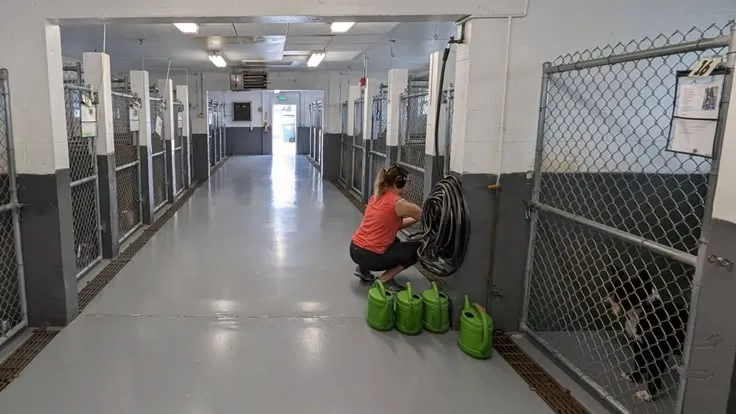
Kennel and veterinary flooring is often judged by the condition of the main walking surface, yet some of the most difficult maintenance problems develop around walls, corners, drains, and equipment bases. These transition areas are exposed repeatedly to wash water, disinfectants, animal waste, and cleaning tools. When poorly detailed, they can become harder to sanitize than the open floor. Facility managers planning a renovation should therefore consider how the flooring connects with surrounding surfaces instead of treating the project as a simple horizontal coating application.
Sharp Corners Complicate Cleaning
Traditional floor-to-wall connections create a ninety-degree corner where dirt, hair, moisture, and cleaning residues can collect. Employees may need extra brushing or manual cleaning to reach these narrow areas effectively.
The challenge becomes greater in kennel runs and wash areas where floors are cleaned frequently. Repeated moisture can expose cracks, failed sealants, or damaged edges along the perimeter.
Designing these transitions carefully can make routine sanitation more straightforward while reducing areas where debris tends to remain after cleaning.
Cove Bases Create Smoother Connections
A resinous cove base extends the flooring material upward along the wall and creates a curved transition instead of an abrupt internal corner.
Facilities considering a professional Kennel Flooring Service can discuss whether cove detailing is appropriate for kennels, treatment rooms, wash areas, or other frequently sanitized spaces.
The objective is not purely aesthetic. A smoother transition can provide maintenance teams with better access during washing and help create a more continuous surface around the room perimeter.
Existing Wall Edges Need Inspection
Installing new flooring does not automatically correct damaged wall connections. Old coatings, cracked concrete, deteriorated sealants, and previous repairs may exist beneath the visible surface.
These areas should be inspected before the new system is installed. Loose or contaminated material may need removal, while damaged concrete should be repaired to provide a stable foundation for the resinous layers.
Ignoring weak perimeter areas can leave vulnerable points even when the center of the floor is properly prepared.
Drainage and Wall Details Work Together
Kennels often rely on regular washdowns, which means water movement should be considered throughout the room. The slope should direct liquids toward drains rather than allow them to collect along walls.
If low areas exist at the perimeter, moisture may remain even after cleaning is complete. A cove base can improve the floor-to-wall connection, but it cannot correct significant drainage problems by itself.
Managers should therefore evaluate slopes, drain locations, and perimeter conditions together during renovation planning.
Cleaning Chemicals Influence Material Choice
Animal-care facilities frequently use disinfectants and detergents as part of daily sanitation. These products can repeatedly contact both the main floor and coved wall sections.
When working with a New Jersey Epoxy Flooring Service, facility operators should explain which cleaning chemicals are used and how often areas are washed.
The flooring specification should account for normal maintenance procedures rather than assuming exposure is limited to plain water. Product compatibility is particularly important in areas cleaned several times during a single day.
Doorways Need Similar Attention
Door thresholds are another type of transition that can become a maintenance and durability concern. Carts, cages, staff, and animals repeatedly cross these narrow areas, concentrating wear.
Different floor elevations or poorly repaired threshold edges can create additional impact. Water may also travel between rooms during washing.
Before resurfacing begins, doorways should be checked for chipped concrete, worn coatings, and uneven transitions so they can be addressed as part of the larger flooring project.
Kennel Partitions Create Perimeter Challenges
Animal runs often contain fixed partitions, gates, posts, or equipment that connect directly to the floor. These points can make cleaning more difficult if gaps or irregular edges remain around them.
Facility managers should identify which fixtures will stay in place during installation and which can be removed temporarily. Better access allows contractors to prepare concrete thoroughly and detail flooring around fixed elements more consistently.
Planning fixture locations before work begins can reduce awkward repair points later.
Maintenance Should Focus on Edges
After installation, inspections should include more than the middle of the room. Wall bases, drain surrounds, doorways, partitions, and equipment edges deserve regular attention.
Small chips, cracks, or damaged transition areas can be easier to repair before repeated washdowns enlarge them. Employees who clean the facility daily are often the first to notice changes, so their observations can become a useful part of preventive maintenance.
Conclusion
Flooring performance in kennels and animal-care facilities depends heavily on details that are easy to overlook. Wall connections, drains, thresholds, partitions, and equipment bases all experience concentrated cleaning, moisture, and traffic.
A well-planned resinous flooring project should therefore address transitions as carefully as the open floor area. Proper substrate preparation, suitable cove details, drainage awareness, chemical compatibility, and routine inspections can create a more practical environment for frequent sanitation. By focusing on these vulnerable edges during renovation, facility managers can reduce recurring maintenance problems and support cleaner, more manageable animal-care spaces.